This decision affects more of your wedding day than any other scheduling choice you’ll make. It changes how many portraits you get, whether you attend your own cocktail hour, how much time your family spends waiting, and what the emotional shape of the morning feels like.
Most articles on this treat it as a matter of sentiment. It’s partly that. It’s also arithmetic, and the arithmetic is rarely explained clearly.
Here’s both sides, with the actual numbers.
What Each One Is
A first look is a private moment before the ceremony where the couple sees each other for the first time, usually with only the photographers present. Portraits follow immediately.
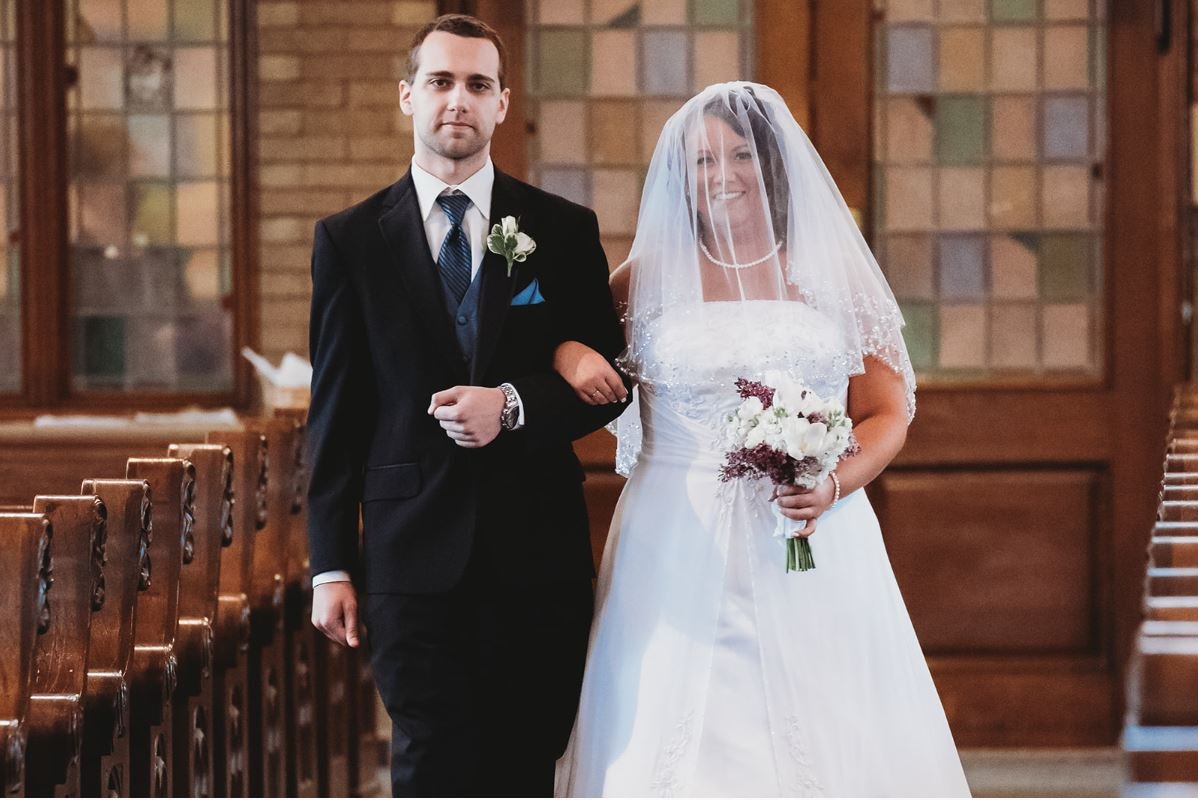
A traditional aisle reveal means the couple doesn’t see each other until the processional. All couple portraits happen after the ceremony.
That’s the whole difference, and everything else follows from it.
The Time Math
This is the part that decides most people’s answer once they see it.
| Element | With First Look | Traditional Reveal |
| Couple portraits before ceremony | 30 to 40 minutes | None |
| Wedding party photos before ceremony | 20 to 25 minutes | None |
| Family photos after ceremony | 20 minutes | 20 minutes |
| Couple portraits after ceremony | 15 minutes at golden hour | 30 to 40 minutes, plus golden hour if timing allows |
| Wedding party photos after ceremony | None needed | 20 to 25 minutes |
| Total post-ceremony photo time | About 35 minutes | About 75 to 85 minutes |
| Cocktail hour attendance | 25 to 30 minutes of a 60-minute hour | Essentially none |
| Total portrait time available | 65 to 75 minutes | 45 to 55 minutes |
Read the last two rows carefully.
A first look gives you more portrait time and more time with your guests. That sounds impossible until you realize the reason: pre-ceremony hours are dead time otherwise. Everyone is sitting in a room waiting. Using those hours costs you nothing.
Without a first look, all the photography compresses into one window that also happens to be the only window where your guests are drinking and eating without you.
The Emotional Argument, Fairly Stated
The case against a first look is real and shouldn’t be dismissed.
There is something specific about walking down an aisle and watching someone’s face change. It’s public, it’s witnessed by everyone who matters to you, and the anticipation has been building since morning. Some couples want that and nothing else will do.
Photographers who tell you the first look is objectively better are overstating it. The aisle reveal produces one moment that a first look cannot reproduce, because the whole room is part of it.
What a First Look Actually Offers Emotionally
The counterargument is also real.
An aisle reveal happens in front of 120 people, on a schedule, with a processional song playing and a photographer eight feet away. Many couples describe being too overwhelmed to register anything.
A first look happens with nobody watching. You can talk. You can hold each other for two minutes. You can say things you’d never say in front of your grandmother. Couples who do it consistently describe it as the calmest, most private moment of the entire day.
It also releases nervous energy. People who were shaking at 2 pm are noticeably steadier at the ceremony.
Neither of these is the right answer. They’re different experiences.
The Myth Worth Killing
“A first look means the aisle moment is ruined.”
It isn’t. Photographers who shoot both consistently report that reactions during the processional are just as strong after a first look. The context is different, the crowd is present, and the emotion is about the ceremony beginning rather than about seeing an outfit.
If anything, couples who’ve had a private moment earlier tend to make more eye contact during the processional instead of freezing.
How to Do a First Look Well
Done badly, it’s awkward. Done well, it’s the best twenty minutes of the day.
The Setup That Works
- Pick a private location in advance. Not the venue lawn where a caterer is unloading. A quiet corner, a garden, a stairwell, a bridge. Your photographer should choose it during the walkthrough.
- Limit the audience to the photographers. No wedding party, no parents, no coordinator. The privacy is the point.
- Have one partner stand facing away. The other walks up and taps a shoulder. Simple, and it gives the photographer a predictable position.
- Do not stage a reaction. Photographers should be far enough back with a long lens that nobody feels performed at.
- Give it real time. Ten minutes minimum, and don’t rush into portraits. The two minutes after the turn are usually better than the turn itself.
- Consider doing letters or gifts here. Reading a letter from your partner in that moment produces images nothing else does.
Variations Worth Knowing
First look with a parent. A father or mother seeing their child dressed for the first time. Frequently more emotional than the couple’s own first look, and almost nobody schedules it.
First touch. For couples who want to preserve the aisle reveal completely: standing on opposite sides of a door or corner, holding hands without seeing each other. You get the private moment and keep the visual reveal for the ceremony. This is an underused compromise and it works well.
Wedding party reveal. The couple seeing their friends dressed. Lower stakes, usually loud and funny, good gallery material.
When a First Look Is Close to Necessary
Certain situations make the traditional route very difficult.
- Winter weddings. A 3 pm ceremony in December means sunset at 4:35 and no daylight portrait time afterward. A first look is the only way to get natural light images.
- Large wedding parties. Twelve or more people take real time. Doing that after the ceremony eats the entire cocktail hour.
- Complex family structures. Divorced parents, step-families, and large extended groups mean a longer family photo list, which squeezes couple portraits.
- Multiple locations. A church ceremony and a reception thirty minutes away leaves almost no post-ceremony window.
- Late afternoon ceremonies in fall. A 4:30 October ceremony ends around 5:05, sunset is around 6:20, and family photos plus wedding party plus couple portraits will not fit.
- Couples who want to attend their cocktail hour. This is a legitimate priority and a first look is how you get it.
When Traditional Works Fine
- Morning or early afternoon ceremonies. A noon ceremony leaves the whole afternoon for portraits.
- Small wedding parties or none. Two people move fast.
- Short family photo lists. Under ten groupings.
- Summer weddings with late sunsets. A 5 pm June ceremony in Buffalo still has four hours of daylight afterward.
- Everything at one venue. No travel time lost.
- Couples who are certain about the aisle moment. If it matters that much, the scheduling costs are worth paying.
A Worked Example Both Ways
Same wedding, same venue, September date, 7:00 pm sunset, 4:30 ceremony.
| Time | With First Look | Traditional |
| 1:00 pm | Getting ready coverage begins | Getting ready coverage begins |
| 2:35 pm | First look | Getting ready continues |
| 2:55 pm | Couple portraits, 35 min | Individual portraits and detail work |
| 3:30 pm | Wedding party, 25 min | Each side photographed separately |
| 4:00 pm | Buffer, guests arriving | Buffer, guests arriving |
| 4:30 pm | Ceremony | Ceremony |
| 5:05 pm | Family photos, 20 min | Family photos, 20 min |
| 5:25 pm | Couple joins cocktail hour | Wedding party photos, 25 min |
| 5:50 pm | Still at cocktail hour | Couple portraits, 35 min |
| 6:25 pm | Reception entrance | Reception entrance, portraits just finished |
| 6:35 pm | Golden hour portraits, 15 min | Golden hour portraits, 15 min if energy allows |
In the traditional column the couple works continuously from 5:05 to 6:25 and misses the entire cocktail hour. In the first look column they get an hour with their guests and the same total portrait output.
That gap is the honest cost of the traditional route. Some couples pay it happily.
What Your Family Will Say, and What to Do About It
Someone will object. Usually a parent, occasionally a grandparent, and the objection is almost always “that’s not how it’s done.”
Two things are useful to know here.
The tradition being defended is not as old as people think. The convention of the couple not seeing each other before the ceremony has murky origins and was never universal. Presenting it as ancient custom overstates the case considerably.
And the objection is usually about something else. It’s about a parent wanting to witness a moment, or feeling the day is drifting from what they pictured. That’s worth addressing directly rather than arguing about history.
A Practical Response
Offer them something instead. A parent first look is genuinely moving and it gives that person a private moment of their own. Most objections dissolve when someone realizes they’re getting a dedicated moment rather than losing one.
You can also invite them to be present in the room right before, but not for the first look itself. The distinction matters and it usually satisfies.
If none of that works, this is your decision and you’re allowed to make it. Say it once, kindly, and move on.
One Line for the Undecided
Do a first touch: hold hands around a corner without seeing each other, get the private moment, keep the aisle reveal.
What to Discuss With Your Photographer
Bring this decision to your photographer early, because it determines the entire timeline structure. Ask them:
- How many total portrait minutes does each option give me at my specific ceremony time?
- Where would the first look happen at my venue?
- What time does my ceremony need to start under each plan?
- Do I get to attend cocktail hour either way?
- If we go traditional, what gets cut if the ceremony runs fifteen minutes late?
That last question is the one that changes minds. In the traditional plan there is no slack, so any delay comes directly out of couple portraits. Experienced Wedding Photography teams will lay this out plainly rather than pushing you toward one answer.
Conclusion
A first look buys you 20 to 30 extra minutes of portraits, an hour with your guests during cocktail hour, less stress before the ceremony, and a private moment nobody else witnesses. It costs you the specific experience of seeing each other for the first time in front of everyone.
The traditional aisle reveal preserves that moment and costs you cocktail hour, portrait time, and every minute of buffer in your schedule.
Choose based on which of those you’d regret more. If the aisle moment is the thing, keep it and add an hour of coverage to pay for the time. If you want the day to feel unhurried and you want to be at your own party, do the first look.
And if you genuinely can’t decide, do a first touch. It’s the one option that gives you most of both, and almost nobody knows it exists.