
You want a divorce. Your wife refuses to sign anything, respond to anything, or even talk about it. So now you feel stuck, and you wonder if she can trap you in the marriage forever.
Here is the good news: she cannot. In the United States, you do not need your spouse’s agreement to get a divorce. This guide explains how the process works, what she can and cannot fight, and how to protect yourself along the way.
The Short Answer: Yes, You Can
Every US state now recognizes no-fault divorce. That means you can file without proving your wife did anything wrong. You simply state that the marriage has broken down, and the court accepts that as a valid reason.
Her consent plays no role in whether the divorce happens. The California Courts Self-Help Guide states it plainly: you do not need your spouse’s agreement to get a divorce, and you can get divorced for any reason. Most states follow the same principle, though the exact rules and waiting periods differ from state to state.
One honest note before you file. If any part of you still wants to save the marriage, try that path first. This guide to healing a struggling relationship with your spouse offers practical steps to consider before you file for divorce.
How No-Fault Divorce Works
Old divorce laws forced you to prove fault. You needed evidence of adultery, cruelty, or abandonment, and your wife could fight those claims in court and block the divorce.
No-fault divorce removed that barrier. According to the Legal Information Institute at Cornell Law School, a no-fault divorce starts with one spouse filing alone, and the other spouse cannot object to the divorce itself. You cite grounds such as irreconcilable differences or the irretrievable breakdown of the marriage.
The court does not dig into your private life. It does not ask who caused the breakdown. If one spouse says the marriage is over, the law treats it as over.
What Happens If She Refuses to Respond
Some spouses try to stop a divorce by ignoring it. They refuse to accept the papers, skip the deadlines, and hope the case dies on its own. It does not work that way.
After you file your petition, the court requires you to serve the papers on your wife. She then gets a set window to respond, usually around 30 days, depending on your state. If she stays silent, you can ask the court for a default judgment.
A default judgment means the case moves forward without her. The judge can grant the divorce and decide the terms based on what you requested in your petition. Her silence removes her voice from the process, not yours.
What She Can and Cannot Contest
Your wife cannot stop the divorce. She can, however, contest the terms. Those are two very different fights, and mixing them up causes most of the stress in contested cases.
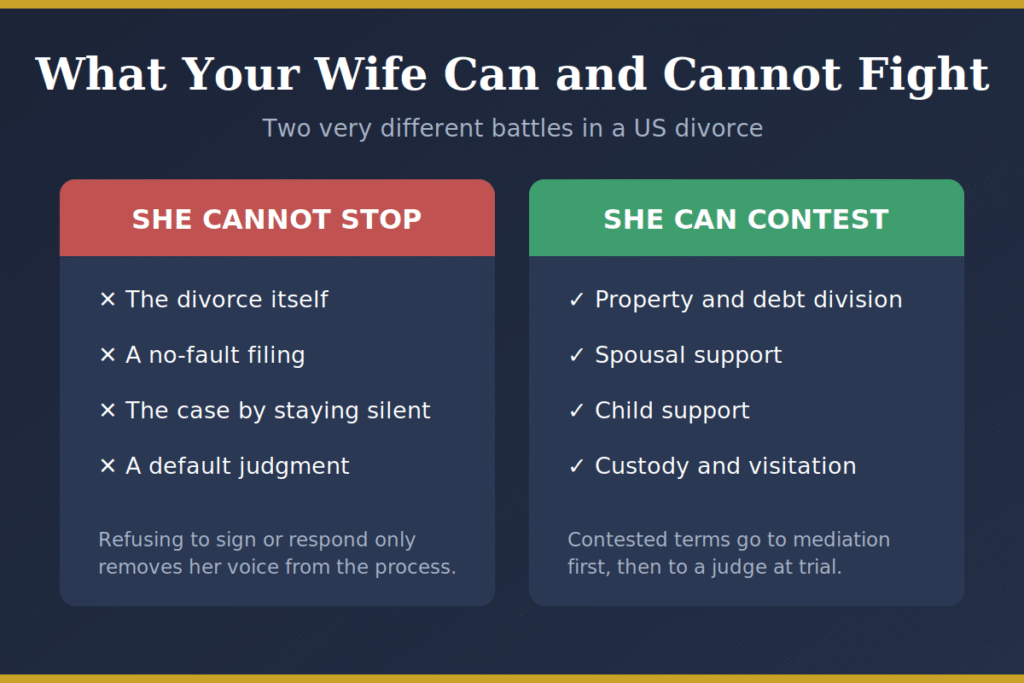
Alt text: What a wife can and cannot contest in a US divorce
The terms include property division, spousal support, child support, and custody. If she disagrees on any of these, the case becomes a contested divorce. You may go through mediation first, and if that fails, a judge decides at trial. Custody fights carry the highest stakes, and preparation matters, as this guide on getting child custody during a divorce explains in detail.
Expect a contested case to take longer and cost more. Many states also set a minimum waiting period, so even a straightforward case cannot be completed overnight. California, for example, requires at least six months from the date your wife receives the papers.
Steps to File Without Her Agreement
The exact forms vary by state, but the path stays the same almost everywhere:
- Check your state’s residency rule. Most states require you or your wife to live there for a set period before you can file.
- File a divorce petition with your local family court and pay the filing fee.
- Serve the papers on your wife through an approved method, such as a process server.
- Wait out her response window. If she responds, the case proceeds as contested or by agreement. If she ignores it, request a default.
- Exchange financial disclosures. Courts require both sides to share income, assets, and debts.
- Finalize the judgment. A judge signs the final order, and your marriage legally ends.
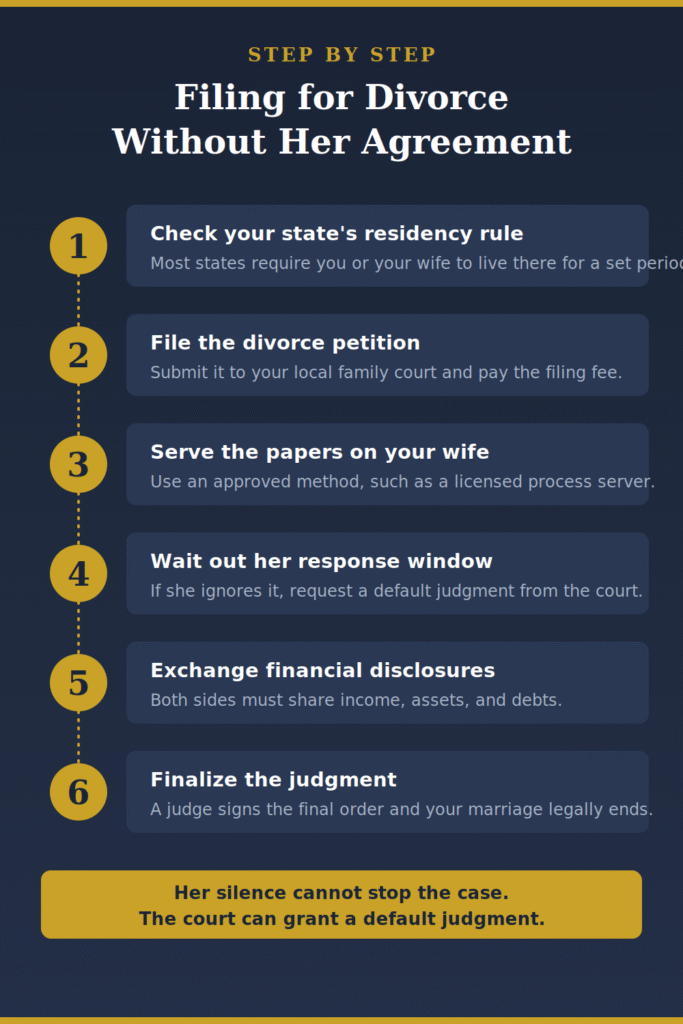
Alt text: Six steps to file for divorce without your wife’s agreement infographic
Keep copies of everything you file and serve. Paperwork mistakes cause more delays in divorce cases than angry spouses do.
The Right Professionals Make This Much Easier
A divorce without your wife’s cooperation gets emotionally heavy fast. You deal with legal deadlines, financial documents, and possibly your kids’ future, all while managing conflict at home. The professionals you choose shape how rough that ride gets.
Look for lawyers, mediators, and financial advisors who hold the Certified Divorce Specialist designation. A certified divorce specialist completes specialized training in the legal, financial, mental health, and real estate aspects of divorce, as well as communication skills for high-conflict cases. That matters most when one spouse refuses to cooperate, because your professional needs to keep the process moving without pouring fuel on the fire.
Ask any professional you interview about their divorce-specific training. Someone who handles divorce cases every week will spot problems that a general practitioner misses.
FAQs
Can my wife refuse to sign the divorce papers?
She can refuse to sign, but it does not stop the divorce. Her refusal only changes the route the case takes.
If she never responds, the court can grant a default judgment and finalize the divorce without her participation.
How long does a divorce take if my wife does not agree?
It depends on your state and how much she contests. A default case can wrap up in a few months, plus your state’s waiting period.
A fully contested case with custody and property disputes can stretch on for a year. Mediation often shortens that timeline.
Do I need to prove she did something wrong?
No. Every US state allows no-fault divorce, so you only need to state that the marriage has broken down. Terms like irreconcilable differences cover this.
Some states still offer fault-based divorce as an option, but you never need it just to end the marriage.
Will I lose custody or property because she did not agree?
No. Courts decide custody based on the child’s best interests and divide property in accordance with state law. Her agreement or refusal does not change those standards.
Refusing to participate usually hurts her position, not yours, because the judge only hears your side in a default case.
Should I hire a lawyer if my wife is fighting the divorce?
Yes, in most contested cases, a lawyer protects you from costly mistakes. Deadlines, disclosures, and custody filings leave little room for error.
Pick someone with real divorce experience, such as a certified divorce specialist, so you get guidance on both the legal and emotional sides of the case.